
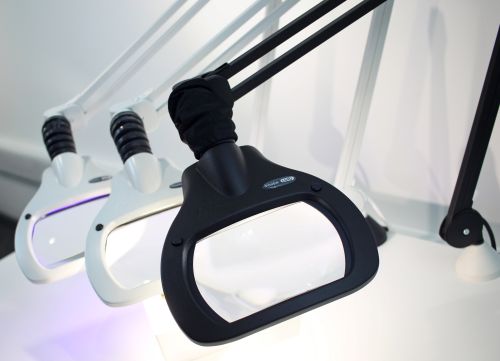
A bench magnifier allows hands-free inspection, assembly, and rework at a workbench or table. It combines a glass magnifying lens with integrated LED lighting on an adjustable arm, allowing small details to be viewed clearly while maintaining a natural working position over longer periods.
Bench magnifiers are used across electronics, manufacturing, jewellery, laboratories, healthcare, dentistry, and technical assembly environments. In these settings, consistent visibility, accurate colour perception, and stable positioning enable routine close-up inspection tasks. For many applications, the essentials are enough. Clear optics, stable positioning, and simple white LED illumination suit bench work where inspection requirements remain broad.
In quality control inspection, the bench magnifier becomes a defined inspection tool rather than a general bench aid. This distinction applies in manufacturing, dental laboratories, medical device production, and clinical preparation areas, where inspection outcomes are defined by regulatory and quality requirements.
Quality control introduces tighter constraints. Visual inspection defines acceptance criteria, informs release decisions, and provides traceability within the production process. Inspection steps are specified, outcomes matter, and consistency becomes critical.
Under these circumstances, general-purpose bench magnification reaches its practical limit. At this point, additional capability becomes necessary to meet defined quality standards within specific sample types and production processes.
Why quality control places different demands on bench magnification
In quality control, inspection conditions are clearly defined, often as part of a standard operating procedure (SOP). Visual requirements are defined, inspection steps are repeatable, and outcomes carry consequences. As such, differences in lighting, magnification choice, mechanical stability, and environmental design become significant, and bench magnifiers are specified accordingly.
Advanced lighting control
Standard white LED illumination suits general inspection but does not reveal all defects or conditions. In quality control, the same product may require different illumination to assess surface detail, contamination, coatings or markings within a defined inspection step. This is particularly important when identifying surface anomalies and preventing defective products progressing through the manufacturing process.
This also applies during assembly verification and rework. During assembly, lighting affects how clearly component placement, surface condition, or alignment can be confirmed before work progresses. During rework or repair, appropriate illumination helps isolate defects, confirm residue removal, or verify corrective actions without reintroducing errors.
Different white light characteristics alter contrast, edge definition, and surface visibility. Changes in colour temperature and light distribution affect how these attributes appear. The ability to select the most appropriate white light conditions for the specific task allows inspection to adapt to different materials, finishes, and inspection objectives without changing equipment.
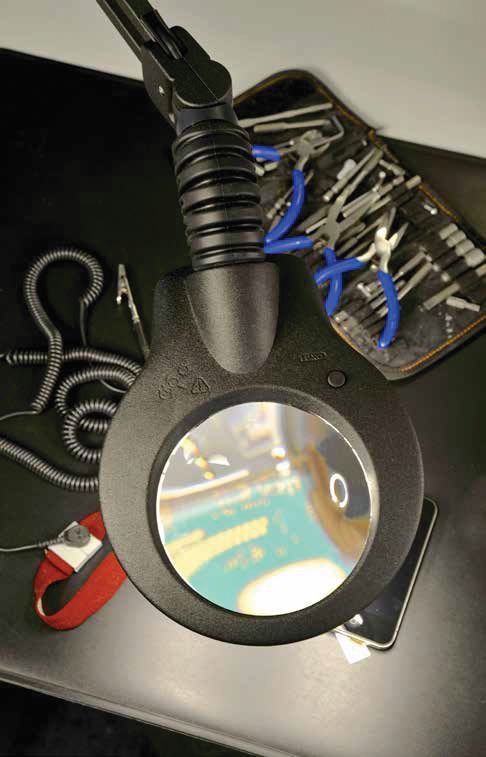
In electronics quality control, white light enables assembly verification, while UV illumination allows the inspection of coatings and reveals residues, contamination, or surface defects not otherwise visible.
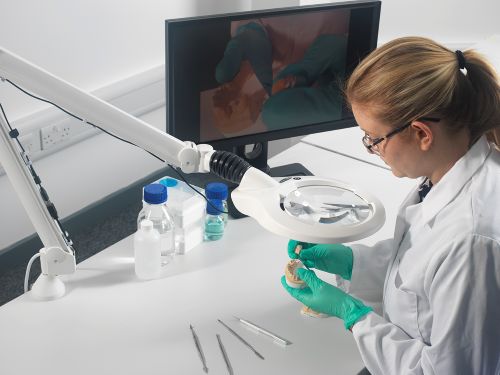
In dental laboratories, inspection often involves verifying margins, surface finish, and material transitions on crowns, bridges, and implants. White light reveals form and finish, while UV illumination exposes residues, bonding agents, or fluorescent markers used during preparation and verification.
In medical device and laboratory inspection, UV illumination is similarly used for cleanliness checks, residue detection, and verification of fluorescent indicators.
In these applications, bench magnifiers with flexible lighting options allow a choice of illumination to match the inspection requirement without having to move or change working position. This maintains consistent inspection conditions without interrupting the workflow.
Task-appropriate magnification options
Quality control inspection often involves multiple inspection steps that require closer examination of specific features, tighter tolerances, or consistent results
across repeated checks. More demanding inspection therefore requires a magnifier specification that matches the task. Using appropriate magnification maintains working distance and field of view while delivering the level of detail required.
The same applies during rework or repair. Correct magnification allows defects to be isolated, excess material to be removed, or fine features to be corrected without affecting surrounding areas.
In manufacturing quality control, this becomes critical when inspection covers both overall part form and small features, such as surface finish, edge condition, or laser markings, within a single inspection step.
Similar requirements apply in dental production, where inspection moves between overall restoration form and fine edge detail, and in plastics manufacturing, where overall moulded form is assessed alongside surface finish, parting lines, or flash.
Selecting the correct magnification from the outset reduces repositioning during use and improves inspection repeatability.
Positional control and balance
During extended or repetitive inspection sessions, the mechanical stability of the bench magnifier becomes important as small movements, gradual drift, or repeated corrections can affect consistency.
In high-throughput quality control areas, such as in-process production checks, even minor instability disrupts inspection flow and increases variation between parts.
Bench magnifiers with refined balancing systems hold position reliably once set and allow smooth, one-handed repositioning. This allows adjustments to be made without putting the part down, reducing interruptions and unnecessary handling while maintaining repeatable inspection conditions. During assembly and rework, this helps preserve part orientation while making small corrections, reducing the risk of additional handling errors.
Designed for controlled environments
Some quality control environments place as much importance on cleanliness as on optical performance. This applies in electronics manufacturing, laboratory inspection, dental production, and medical device manufacturing, where dust or debris can adversely impact the quality control process.
Covered or enclosed joints reduce exposed areas where particles can collect and simplify equipment cleaning. These design choices help maintain consistent inspection conditions.
Ergonomics that remain consistent under sustained use
Human comfort affects inspection performance. Poor posture, repeated reaching, or frequent repositioning increase fatigue and reduce accuracy over time.
This is more likely during prolonged inspection sessions or repetitive bench work, where posture and movement remain largely unchanged.
Together, stable positioning, smooth, controlled movement, appropriate magnification, and lighting reduce the need for repeated adjustment during prolonged inspection. Features are easier to see, visual and physical strain is reduced, and inspection becomes more consistent and efficient.
Consistency
In quality control, consistency comes from assigning a bench magnifier to a defined inspection, assembly, or rework step, rather than expecting one tool to cover multiple requirements. When magnification, lighting, and positioning are specified for a single task and kept fixed, inspection conditions remain repeatable and outcomes remain comparable.
This task-specific approach limits variation between checks and supports confidence in inspection results, particularly where the same inspection step is repeated across production runs.
Where Vision LUXO fits
Vision LUXO sits between general bench magnifiers and more complex inspection systems, such as OPTA, Mantis and Lynx EVO. It addresses defined quality control tasks with fixed inspection criteria and tighter visual requirements. Typical applications include electronics quality control, dental laboratory inspection, medical device preparation, and laboratory verification tasks where inspection outcomes influence acceptance or release decisions.
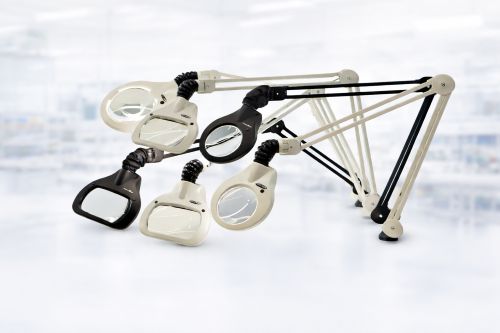
Within the Vision LUXO range, models such as Wave, Circus, and KFM offer different mechanical designs and configuration options to suit specific workspaces and inspection tasks. Capability increases through specification, such as lighting options or design features for controlled environments, rather than through a single model hierarchy.
Rather than replacing entry-level bench magnifiers like ClearView DUO or HEPTA, Vision LUXO is specified for inspection steps that require greater control over lighting, positioning, and repeatability. In many environments, it operates alongside more basic bench magnifiers, with each tool assigned a defined role within the quality control process.
This task-specific approach allows quality control teams to match each bench magnifier to a defined inspection requirement, rather than relying on a single tool to cover every application.
Bench magnifiers as part of the quality control process
In quality control, the effectiveness of bench magnification depends less on having more features and more on using the right tool at the right inspection step. As inspection criteria tighten and processes become more structured, bench magnifiers shift from general-purpose aids to part of the inspection system itself. Specifying magnification, lighting, and mechanical behaviour at this level helps maintain control across repeatable inspection processes.
With long-standing experience in visual inspection and ergonomics, Vision Engineering Ltd focuses on offering practical, reliable solutions for everyday bench work and defined quality control tasks. The ClearView range, including HEPTA and DUO bench magnifiers and OPTILITE task lights, addresses everyday requirements where simplicity and ease of use matter most.
For more demanding applications, Vision LUXO extends this approach into environments where inspection criteria are fixed and control, repeatability, and specification become more important. Together, these ranges reflect a consistent focus on usability, reliability, and task-appropriate bench magnification, supported by specialist knowledge and long-term product support.