Founded in 1979 by Malcolm Jordan and John Harding, MJ Sections has grown from a two person workshop into a trusted aerospace supplier. The company has steadily expanded its capabilities to include sheet metal fabrication, precision machining, EDM, vacuum heat treatment and tooling design.
Longstanding approvals from major aerospace customers and a commitment to engineering R&D mean MJ Sections is well placed to take on complex projects. MJ Sections is recognised for solving difficult manufacturing challenges and adapting its capabilities to each component.
The Challenge: Honeycomb Bond Integrity Inspection
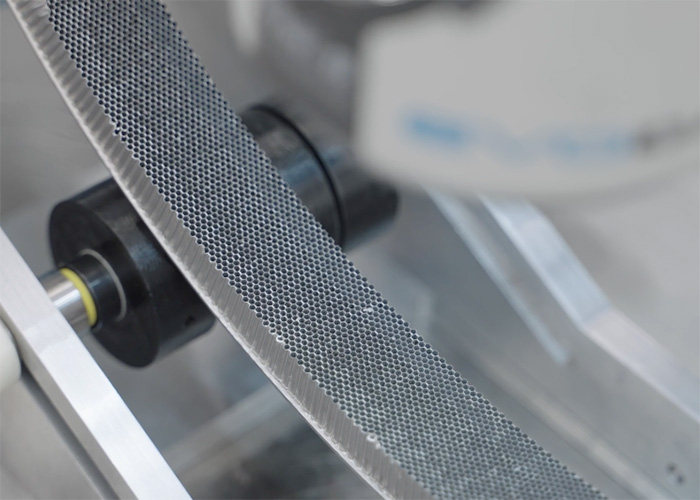
When honeycomb rings were introduced as a new PROJECT from a major aerospace customer, MJ Sections was tasked with developing the process to meet strict inspection requirements. The rings are critical for engine performance. Inside turbine engines, honeycomb rings act as abradable seals. As blades expand under full thrust from centrifugal force and thermal growth, they cut slightly into the honeycomb surface. This creates a tight gas seal that prevents leakage and improves efficiency. For safety and reliability, every bond within the honeycomb structure must remain intact, since any loose section could damage the engine.
Special Process Manager Mick Hollis led the effort, working through the specifications and identifying the need for a reliable visual inspection method. The specification required 100% visual inspection of every cell to confirm bond integrity. With thousands of cells per ring and multiple rings in each batch, this was a demanding task.
Traditional microscopes were unsuitable. They provided too much magnification, giving only a narrow view of the honeycomb, when operators needed to see whole cells in context. They were also physically restrictive, with short working distances and limited movement that prevented operators from positioning large rings under the lens.
The alternative was to use fibre optics, inserting a light into individual cells to detect unbonded areas by seeing if light passed into neighbouring cells. This was extremely slow and impractical for large-scale inspection.
Faced with this scale of inspection and no immediate answers, MJ Sections needed to find a new inspection method that was thorough, efficient, and ergonomic.
The Solution: EVO Cam II Inspection System
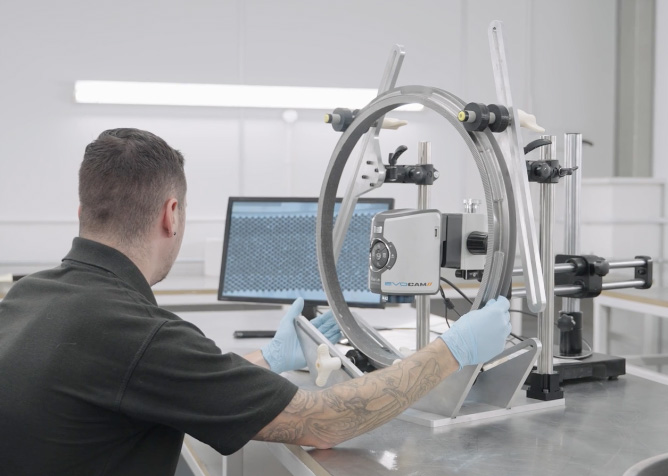
At a trade show, Hollis spotted EVO Cam II and immediately recognised its potential for honeycomb inspection. Its image clarity and the flexibility of the double arm boom, which allowed the camera to be positioned easily over large rings, provided the access that microscopes could not.
MJ Sections designed a custom fixture with high intensity lighting to illuminate the honeycomb cells. With EVO Cam II positioned above, operators could rotate the ring during inspection and check bond integrity in every cell. The wide field of view, lighting options, and autofocus meant operators could work quickly while maintaining accuracy.
Unlike microscopes, EVO Cam II gave a complete view of the honeycomb structure along with the working distance required for large parts. Operators could adjust the double arm boom in and out as needed, covering the full inspection area. This eliminated the slow fibre optic method and made large-scale inspection practical.
The Outcome
EVO Cam II allowed MJ Sections to establish a new standard operating procedure for honeycomb ring inspection. The system is now in full-time use, supporting 100% bond integrity checks without the delays of fibre optics or binocular microscopes.
Operators can quickly identify any unbonded cells and, when required, escalate to higher magnification tools or non-destructive testing. The clarity, ergonomics, and illumination reduce fatigue during long inspection sessions, helping staff stay consistent across large inspection volumes. The system has been occasionally loaned to other inspection teams, but always returned quickly due to its essential role in honeycomb production.
“I walked past EVO Cam II at the NEC and it stopped me in my tracks. I knew straight away that it was the answer. Traditional microscopes were no good, and fibre optics would take forever. With EVO Cam II, we can check thousands of cells quickly and confidently.”
– Mick Hollis, Special Process Manager, MJ Sections
Key Benefits of EVO Cam II
- Created a new inspection SOP for bond integrity checks.
- Clear visual confirmation of bond integrity across thousands of cells.
- Double arm boom provided flexibility for different ring sizes.
- Illumination options and autofocus improved efficiency.
- Reduced operator fatigue compared to microscopes or fibre optics.
- Integrated with custom lighting fixture and workflow.
Conclusion
By adopting EVO Cam II, MJ Sections turned bond integrity inspection of honeycomb rings into a repeatable, efficient process.
EVO Cam II inspection system supports aerospace safety by ensuring every bond is secure, while also showing how adaptable inspection technology can integrate effectively into specialised workflows across the industry.
FAQs
Can EVO Cam II inspect turbine honeycomb structures?
Yes, its autofocus, wide field of view, and double arm boom make it ideal for examining thousands of small cells across a large ring.
Why not use a traditional microscope for honeycomb inspection?
Microscopes provided excessive magnification, a narrow field of view, and limited working space, making them unsuitable for large honeycomb rings.
Can EVO Cam II be integrated with customer tooling?
Yes, MJ Sections combined EVO Cam II with a custom-built lighting fixture to achieve the required inspection clarity.
Does EVO Cam II replace high-magnification analysis?
To some extent. EVO Cam II provides fast and reliable first-pass inspection, and its 30:1 optical zoom also allows high-magnification examination of specific areas when needed. Suspect regions can then be reviewed further using higher-power tools or non-destructive testing if required.
What industries benefit from EVO Cam II inspection systems?
Aerospace, defence, medical, and precision engineering companies use EVO Cam II for inspection of detailed components where clarity, flexibility, and speed are critical.