Safety-critical PCB inspection plays a central role in aerospace, defence, and other high reliability applications. Printed circuit boards used in these environments are often complex, double sided, and built to tight tolerances. Inspection must identify defects that could lead to failure, while allowing necessary rework to be carried out accurately and safely. The case study explores how one aerospace electronics manufacturer improved quality control and rework performance by reassessing working distance, field of view, ergonomics, documentation and workstation setup within their existing inspection process.
Inspection context from the customer environment
The customer manufactures safety-critical PCB assemblies for aerospace and defence programmes. Boards are high specification and double sided and can be awkward to handle during inspection and rework.
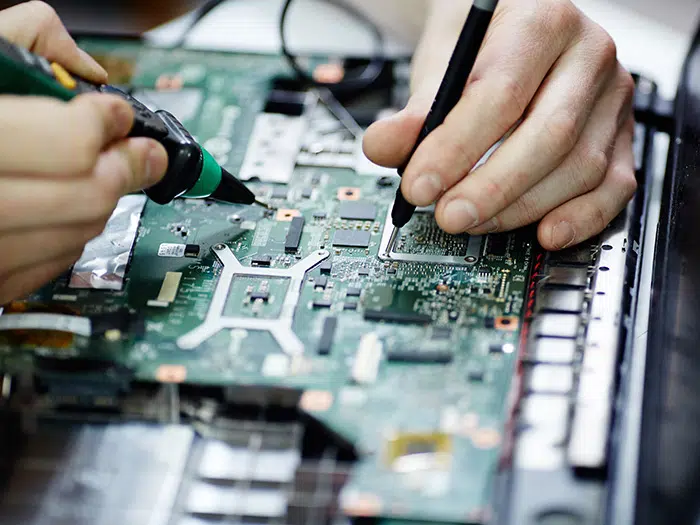
PCBs are mounted in custom fixtures and regularly flipped or tilted to access solder joints, connectors, and components located in difficult positions. Inspection and rework are carried out manually by experienced operators, often working for extended periods at magnifications of up to 25x.
The customer had experienced repeated objective damage and contamination during PCB reworking due to insufficient working distance with their existing stereo microscopes. Although automated inspection and electrical testing are used elsewhere in the manufacturing process, this case study focuses on the manual visual inspection and rework stage, where judgement, depth perception, and operator control are critical.
The role of manual visual inspection in safety-critical PCBs
Automated optical inspection, automated X-ray inspection, and in-circuit testing all play an important role in detecting obvious defects and improving test coverage in PCB manufacturing. However, they do not replace manual visual inspection in safety-critical applications.
For this customer, manual inspection was essential to:
- Assess solder joints in context
- Judge component seating and alignment
- Investigate areas flagged during earlier inspection stages
- Support failure analysis and controlled rework
Because boards are regularly flipped or tilted in fixtures, inspectors must maintain clear visibility and control while working at varying angles. Equipment must therefore support stable viewing, sufficient working distance, and consistent image quality during both inspection and rework.
Why working distance mattered in this case
Working distance was the most significant challenge in the customer’s existing inspection setup.
Standard stereo microscopes positioned the optics close to the PCB, creating several practical issues:
- Restricted access for soldering irons, tweezers, probes, and hot air tools
- Frequent contact between tools and objectives
- Increased risk of flux fumes and splatter contaminating optics
- Reduced confidence when inspecting or reworking hidden joints
Damaged objectives caused downtime and unnecessary cost. More importantly, operators were forced to adapt their technique to the equipment, rather than the equipment supporting the task.
Increasing working distance was identified as the highest priority.
Field of view and orientation on complex boards
This application also highlighted the importance of field of view.
Inspectors needed to see sufficient surrounding context to maintain orientation when boards were flipped or tilted in fixtures. Limited field of view meant boards were frequently repositioned simply to bring adjacent features into view.
A wider usable field of view reduced the need for constant repositioning, helping operators maintain flow and concentration during detailed inspection and rework. At higher magnifications, maintaining clear context was important to avoid slowing inspection or increasing the risk of missed defects.
Ergonomics during extended inspection and rework
Extended inspection and rework sessions were common in this environment.
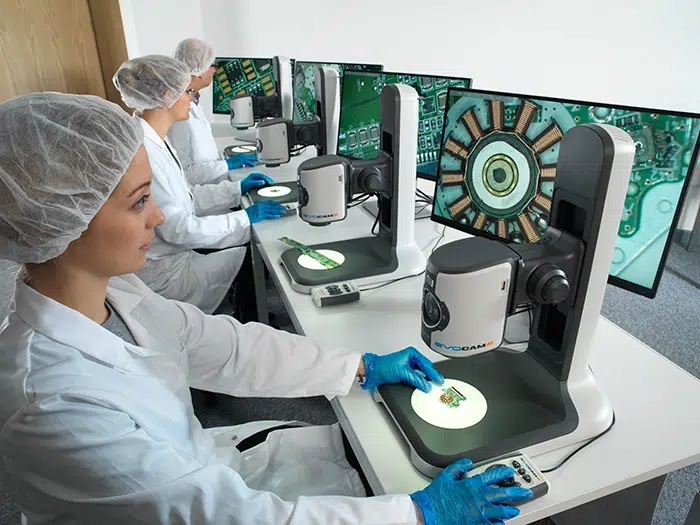
With boards frequently tilted or repositioned in fixtures, maintaining a stable and comfortable viewing position was challenging. Traditional eyepiece-based systems required operators to align closely with the optics, which could affect posture during longer sessions.
For this customer, fully digital, screen-based viewing allowed operators to work at varying board angles without adopting fixed viewing positions, reducing strain during longer tasks.
Documentation and traceability requirements
Documentation and traceability are essential in aerospace and defence manufacturing.
The existing quality control setup offered no simple way to capture images. Inspection records relied on written notes and subjective assessment, making it difficult to apply inspection criteria consistently between operators and shifts.
The customer required straightforward image capture to support reporting, sign-off, and contract traceability. Because boards were regularly tilted or rotated during inspection and rework, maintaining a stable and consistent image for documentation was also important.
A fully digital inspection platform provided a clear advantage, enabling reliable image capture without interrupting workflow or repositioning equipment.
Stand and workstation flexibility in safety-critical PCB inspection
Workstation layout was another practical consideration. Inspection and rework were carried out on benches shared with fixtures, tooling, and test equipment.
The inspection system needed to integrate into the existing setup without disrupting established workflows. Adjustable stand options allowed the system to accommodate different board positions and fixture heights, while maintaining stable viewing during angled rework.
This supported shared use between operators and shifts, helping maintain consistency across the process.
Supporting the inspection process with EVO Cam II
To address these requirements, the customer adopted EVO Cam II configured with long working distance lens options.
EVO Cam II provided the extended working distance required for safe tool access during PCB rework, reducing the risk of objective damage and contamination from flux. Operators were able to work confidently under the optics, even when boards were tilted or repositioned within fixtures.
High-resolution digital imaging supported detailed inspection of solder joints and components at magnifications up to 25x. Fully digital, screen-based viewing improved operator comfort and allowed stable inspection and rework at varying board angles. The integrated camera enabled straightforward image capture for traceability, reporting, and defence contract documentation, without interrupting workflow.
Adjustable stand configurations allowed the system to integrate into shared workstations while maintaining stable positioning and consistent setup between
operators and shifts.
Outcomes observed in the case study
As a result of these changes, the customer reported:
- Improved tool clearance during PCB rework due to extended working distance
- Reduced objective damage and contamination
- Greater confidence when working on boards positioned at varying angles
- Improved operator comfort through screen-based viewing
- Clear digital image capture to support traceability and sign-off
Overall, inspection and rework became more controlled, repeatable, and better aligned with the demands of safety-critical electronics.
Why this case study matters
This customer case study shows that in safety-critical PCB inspection and rework, equipment must support how engineers and inspectors work.
Long working distance, usable field of view, stable digital imaging, ergonomics, and reliable documentation directly influence inspection quality, confidence, and
consistency. Addressing these fundamentals can reduce risk, protect equipment, and improve repeatability without adding unnecessary complexity.
FAQs
What is safety-critical PCB inspection?
Safety-critical PCB inspection focuses on detecting defects that could lead to failure in regulated applications such as aerospace, defence, and medical devices, where reliability, traceability, and compliance are essential.
Why is manual visual inspection still required in safety-critical applications?
Manual visual inspection allows trained operators to assess solder joints, component alignment, and subtle defects that automated optical inspection, X-ray inspection, or electrical testing may not fully capture. It also supports controlled rework where precision and judgement are required.
Why did working distance matter in this case study?
Extended working distance provided clearance for soldering and probing tools, reduced the risk of damaging optics, and allowed confident inspection and rework at awkward angles created by fixed board fixtures.
Why does stand and workstation flexibility matter for PCB inspection?
Flexible stand options help accommodate custom fixtures, board rotation, and limited bench space. Adjustable stands also make it easier to share inspection systems between operators and shifts while maintaining consistent setup and working posture.
Why is digital image capture important in aerospace and defence PCB inspection?
Digital image capture supports documentation, reporting, and contract traceability. It reduces reliance on written notes alone and helps maintain consistent inspection standards across operators and audit requirements.
When would a stereo system be more suitable?
A stereo inspection system may be preferred where natural depth perception is the primary requirement, particularly in applications involving complex 3D assemblies or tasks that rely heavily on visual depth cues rather than documentation and image capture.
When is digital stereo 3D inspection beneficial?
Digital stereo 3D inspection can be beneficial where depth perception is required alongside digital collaboration, for example when multiple users need to view and assess the same inspection image simultaneously for peer review, training, or remote support.